Who changes your AI agents when your priorities change?
Agents usually start with the work people least like doing, from a brief written once. When the direction moves, the agents keep working to the old brief.
RELIABL.IT gets your agents running fast, and keeps them up to date every time your action plan changes.
AI pilots rarely bring the business benefits that matter.
Most companies start with pilots that are easy to build: meeting summaries, email triage, answers to HR questions. They save some time, and people like them. Revenue, margin and growth stay where they were, because nobody chose the pilots for that.
What it looks like today:
- A dozen agents summarise meetings. None of them touches revenue or margin.
- IT picked the use cases. Nobody asked which problems were worth solving.
- The pilot looked great in the demo. Eight months later, it is still a pilot.
- Priorities changed in June. Only the builder can change the agents.
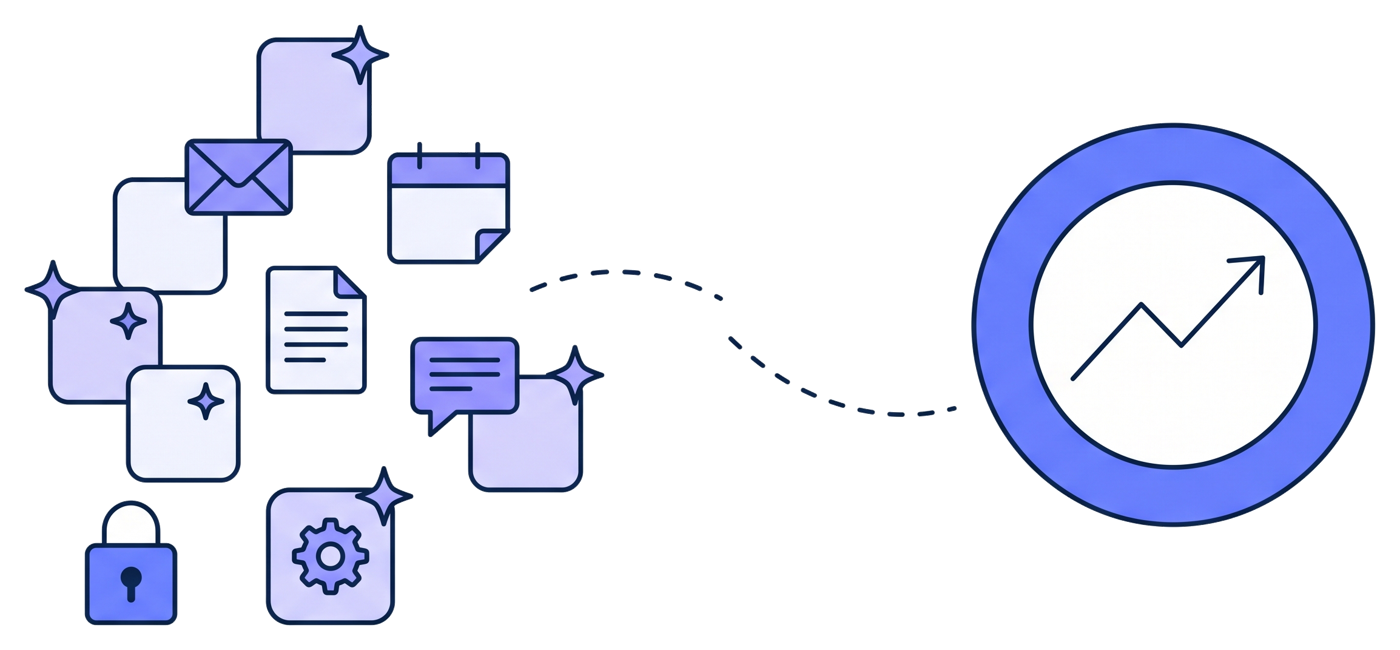
Agents are built from a use case and a one-time brief. Nothing ties them to the goals, and nothing changes them when the goals change.
Use case first.
The use case is chosen because it is easy to automate. So the agent saves time in work that was never going to move the numbers the company is measured on.
Outside the action plan.
The agent has no goal, no KPI and no owner in the action plan. Nobody can say what it is for, or whether it worked.
Frozen at build time.
The brief lives in the builder's head and in the agent's setup. When the direction changes, the agent needs its builder again: a new request, a new price and a wait.
Three ways companies get AI agents today, and where each one stops.
An AI agency, or the AI vendor's engineers
An agency, a systems integrator, or the AI vendor's engineers on site.
Good at
Real builders, and fast to a working agent.
Where it stops
They build what you specify. If someone else builds your agents, someone else has to change them every time your business changes.
Build it in-house
An agent builder in the tools you already license, and an enthusiast in each department.
Good at
Cheap to start, and close to the work.
Where it stops
Your team still decides which agents should exist, ties each one to a goal, and keeps every one current.
The AI features in the tools you own
The assistant in your CRM, your ERP or your office suite.
Good at
No procurement, and often already paid for.
Where it stops
Each one improves its own tool, and none of them knows your priorities.
What it looks like when it is fixed.
- Every agent task serves a named goal in the action plan, with a KPI and an owner.
- Each agent has written instructions: what it may do, which systems it may reach, and where it must stop and ask.
- A person approves every real action on the early runs.
- When the action plan changes, the instructions for the affected agents change at once, after a person approves.
- The agents run on your systems, with the model you chose.
Agent instructions written from the action plan, and kept current.
RELIABL.IT writes the agent instructions from the action plan. Every task marked for an AI agent gets instructions that say what the agent may do, which systems it may reach, and where it must stop and ask. Your agents read them through the MCP server and run on your systems, with your model account.
When the action plan changes, RELIABL.IT changes the instructions for the affected agents, after a person approves. Nobody has to work out which agents need changing, and nobody has to brief a builder again. It is part of the subscription.
Many companies have their first agents running within 30 days.
✦ AGENT ARTIFACTS
Inventory European markets
System prompts, skills and task instructions for this task.
Task instruction Served to the agent through the MCP server
inventory_european_markets
Overview
Establish the validated baseline for every existing non-DACH European market, covering commercial performance, customers, pipeline, product languages, delivery, support, customer success and partners.
When to Use / When Not To
Use as the first analytical task. Do not use to approve countries, set targets or infer facts where source data is absent.
Prerequisites & Access Required
Obtain read access to CRM, finance, customer, product-language, implementation, support, customer-success and partner systems; confirm country and period definitions.
High-Level Workflow
Extract, normalize, reconcile, map coverage, document gaps and publish the inventory.
Input Contract
Input is the initiative brief and authorized source-system extracts; no predecessor task is required.
Step-by-Step Procedure
1. Define the non-DACH country universe, reporting period, currency, revenue and bookings definitions, customer-status rules, pipeline qualification standard and source priority.
2. Extract country-level revenue, bookings, customers, qualified pipeline, opportunities, win rate, sales cycle and close-date data from finance and CRM systems.
3. Reconcile country totals to reported corporate figures and preserve source discrepancies with explanations.
4. Map current software-language, product, implementation, integration, support, customer-success and partner coverage by country.
5. Record source dates, field definitions, missing values, data-quality issues, assumptions and known exclusions for every country.
6. Validate the inventory with finance, CRM and operating-data owners and capture corrections or explicit exceptions.
7. Publish the country-by-country inventory and a data-gap register for segmentation and modeling.
Output Contract
Produce the validated non-DACH market inventory and data-gap register. Task 11636 consumes the inventory for segment analysis; task 11637 consumes its commercial baseline.
Quality Checklist
Every existing market appears; commercial figures reconcile or discrepancies are explained; coverage maps are complete; data gaps and assumptions are explicit; validation owners and dates are recorded.
Error Handling & Edge Cases
Do not merge countries because of regional account structures without a documented allocation rule. Preserve multiple reported values when reconciliation is pending. Mark zero, missing and not-applicable distinctly. Escalate inaccessible systems or unowned definitions.
Escalation & Human-in-the-Loop Rules
Finance, CRM and operating owners validate definitions and corrections. The agent may analyze authorized data but must not certify financial truth independently.
Guardrails (Hard Constraints)
Use existing non-DACH markets only. Do not fabricate values or fill gaps with estimates unless explicitly labeled and approved for modeling.
Worked Example
If a regional customer is booked centrally, retain the source value, document the allocation issue and exclude it from country comparisons until finance confirms an allocation method.
Maintenance Notes
Refresh the inventory for each planning cycle and whenever source definitions or country ownership changes.
Next to an AI agent agency.
An AI agent agency
- The agent's work comes from a use case you specify
- It serves the brief
- The instructions are built into the agent
- When your direction changes: a change request, with its own price and a wait
With RELIABL.IT
- The agent's work comes from a task in the action plan, tied to a goal
- It serves a named goal, with a KPI and an owner
- RELIABL.IT writes the instructions and serves them to your agents
- When your direction changes, the affected instructions change after you approve, in the subscription
Agents are the third part of the loop.
They work from the action plan, and Dynamic Strategy keeps their instructions current when the market moves.
See it on an example company.
First action plan in minutes. You set the pace from there.