Think of the last decision that needed three departments.
How long until all three were working on it, and were they working on the same thing?
RELIABL.IT turns the strategy into one action plan for every department within minutes: objectives, KPIs, actions and tasks, with owners and dates.
The strategy comes apart where the department plans are stitched together.
The leadership team agrees the strategy, often at an offsite. Then each department goes into its own planning. It sets its metrics, defines its projects and estimates what it needs. Weeks later the plans come back, each in its own format, and someone stitches them together.
What it looks like today:
- Every department sends back last year's KPIs, plus five percent.
- Two teams plan the same project. Nobody plans the work between them.
- Marketing launched the campaign before production was ready.
- Agreeing the targets took nine weeks. The quarter was half gone.
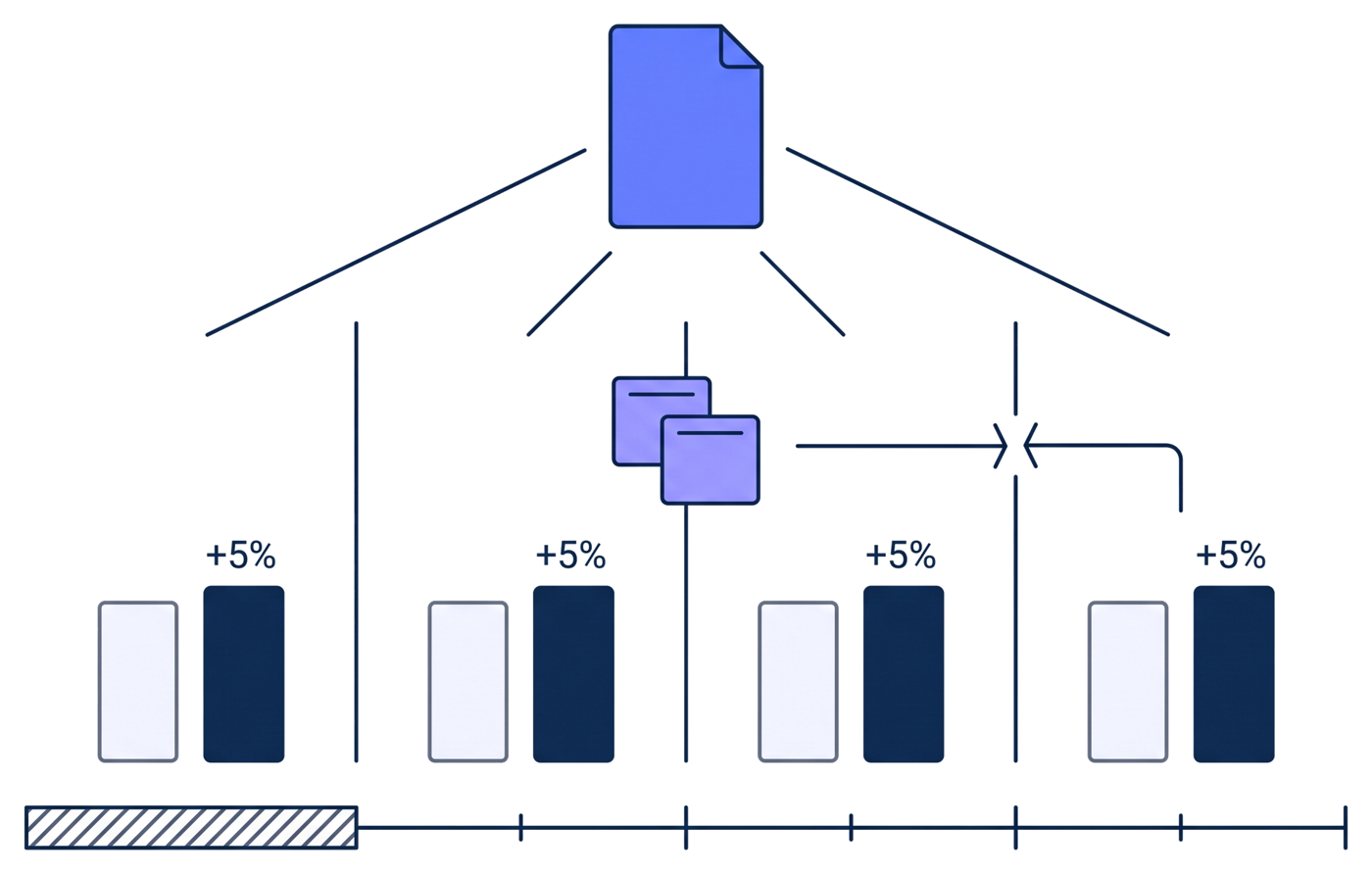
Each department translates the strategy by hand, from its own past. So the action plan arrives late and looks like last year.
Each team plans from what it knows.
People promise what they can surely deliver. So the new bets in the strategy get thin plans, and familiar work gets thick ones.
Nobody owns the joins.
The work between departments sits in nobody's plan. When it falls through, each team has a reason, and the reason is another team.
Translation by hand is slow.
Every department writes, reviews and negotiates its own plan. By the time the plans agree, they have drifted from the strategy, one reasonable adjustment at a time.
Three ways companies turn a strategy into work today, and where each one stops.
OKR and goal tools
Goal-tracking software, strategy dashboards, check-ins.
Good at
It makes goals visible, runs the check-ins and shows what is off track. Its AI now helps draft goals and metrics.
Where it stops
Your teams still write the objectives, KPIs and actions, and the tool tracks them. When the strategy changes, they rewrite them by hand.
A programme office, or consultants who build the plan
A transformation office, a consulting team, a planning workstream.
Good at
Thorough, with someone accountable for the whole plan.
Where it stops
Slow and costly, and the plan is a document. Every change goes back through the same people.
Spreadsheets and the annual planning cycle
A template per department, put together by finance.
Good at
Familiar to everyone, and it fits the budget.
Where it stops
Each department fills in its own sheet, and the work between the sheets belongs to nobody.
What it looks like when it is fixed.
- Every department starts from the same action plan within days of the decision.
- Every action traces to a line of the agreed strategy, with an objective, a KPI, an owner and a date.
- The order is set, so each department knows what comes first.
- Each task says whether a person, an AI agent or both do the work.
- When something slips, the owner is clear, and nobody asks whose task it was.
One action plan, top down, for every department.
RELIABL.IT translates the strategy top down. It suggests the objectives and KPIs that serve each goal. Then it writes the actions and tasks, with owners, estimates and dates, all aligned to the agreed strategy. Your managers change what they want.
Each task is marked for people, for AI agents or for both, and the tasks export to CSV for Jira or any other project tool. If your teams track KPIs in another tool, they can keep it: RELIABL.IT makes sure the KPIs they track serve the strategy.
In the example on the Platform page, one action has 13 tasks, all aligned to the agreed strategy: 7 for people and 6 for AI agents.
Annual planning works the same way. The action plan reaches every department in days, and the monthly realignment keeps it current through the year.
ACTION #11567
Execute European International Growth Program
OPEN HIGH 69d est
Focus international expansion on existing European markets outside DACH by selecting priority countries and segments, quantifying revenue and pipeline contribution, and aligning localization, multilingual product support, implementation, customer success, partnerships, sales capacity and country-specific labor, privacy and compliance readiness, while addressing that non-DACH revenue reached only 8% in H1 2026 and remains under-diversified.
Objective
International Market Strategy
Timeline
Oct 12, 2026 → Feb 5, 2027
Tasks 13
TASK · Inventory European markets
Responsible owner
International Strategy Lead
Key performance indicator
100% of existing non-DACH European markets have documented revenue, customer, pipeline, language and capacity baselines or explicitly logged data gaps
Timeline
Oct 12, 2026 - Oct 15, 2026
Action items
- Extract country-level revenue, customer, bookings, pipeline and win-rate data from CRM and finance systems
- Map current product-language, implementation, support, customer-success and partner coverage by country
- Document data gaps, assumptions and baseline definitions
- Publish the validated non-DACH market inventory
Next to OKR and goal tools.
OKR and goal tools
- Your teams write the objectives, KPIs and actions, with AI help on goals and metrics
- Usually goals and initiatives; tasks live in project tools
- AI assistants that report on the work
- When the strategy changes, your teams rewrite the goals
- Weeks to set up, then the planning cycle
With RELIABL.IT
- RELIABL.IT suggests the objectives, KPIs and actions from the strategy; your managers decide
- Actions and tasks, with owners, estimates and dates
- Each task marked for people or AI agents, with instructions for the agent tasks
- When the strategy changes, RELIABL.IT proposes the changes to the action plan; you approve
- First action plan in minutes
A category, not a vendor: how OKR and goal tools usually work, from public material in October 2026.
The action plan sits in the middle of the loop.
The strategy feeds it, the AI agents work from it, and Dynamic Strategy keeps it current.
See it on an example company.
First action plan in minutes. You set the pace from there.